
Fossil bone study desk for cancer genetic mutations and evolution at PULSE TCM

Insights · Opinion · General Health

Cancer: A Case of Good Design Turned Awry

Multi-hit mutations and age raise odds; hereditary, environmental, and replicative drivers share the load. The same mutational force that shaped life can, without restraint, drive malignancy inside one lifespan.

In brief

Cancer is a genetic disease of accumulated mutations. Most single changes are harmless; malignancy usually needs multiple hits, which is why risk rises with age. Damage arrives through hereditary predisposition, environmental insult, and random errors when cells copy DNA. Across studied cancer types, about two-thirds of promoting mutations were attributed to replicative chance, with smaller shares from environment and inheritance. Cellular defences such as TP53 and telomeres normally restrain rogue growth.

01 · Deep time

Life evolved; cancer hitchhiked on the same code

Roughly 3.6 billion years separate single-celled marine life from land-walking vertebrates. Fish, jaws, cartilaginous and bony lineages, lobed fins on land, then amphibians, reptiles, mammals, and humans: each step was morphology under survival pressure.

To the oncologist, that deep-time sketch is not a nature documentary. It is gene mutation at work: the same process that can, without restraint, drive malignancy inside one lifespan.

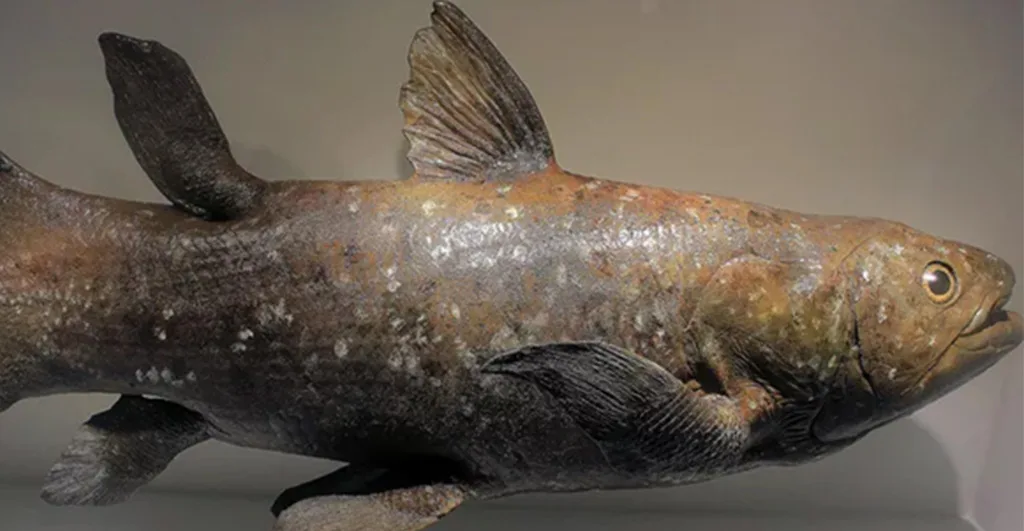
Coelacanth specimen showing lobed fins for cancer genetic mutations evolution

02 · Mutation as evolution

What the oncologist sees in 530 million years

Genes · Genome · Natural selection

The coelacanth is a Devonian lobed-fin fish and a living fossil. Evolution is survival necessity; morphology follows function.

That is why pigs have trotters and we have fingers and toes. I say that again: fingers and toes, not fingers or toes. Pigs appear here for a genetic reason that becomes plain below.

Traits accumulate and are coded in genes inside living cells. Genes are linear molecular sequences; the full complement is a genome. The human genome has some 20,000 genes across nuclear DNA in 23 chromosome pairs plus mitochondrial DNA. Genes instruct cells how to make proteins. Humans are about 99.9% genetically alike and share roughly 98% of their DNA with pigs.

Under ordinary conditions DNA stays aligned with environmental demand. Evolution through natural selection is successful adaptation under harsh change. At the cellular level, evolution is a gradual accumulation of mutations driven by altered DNA, especially in the germ line. Most mutations help survival and can pass down generations. Occasionally they turn harmful.
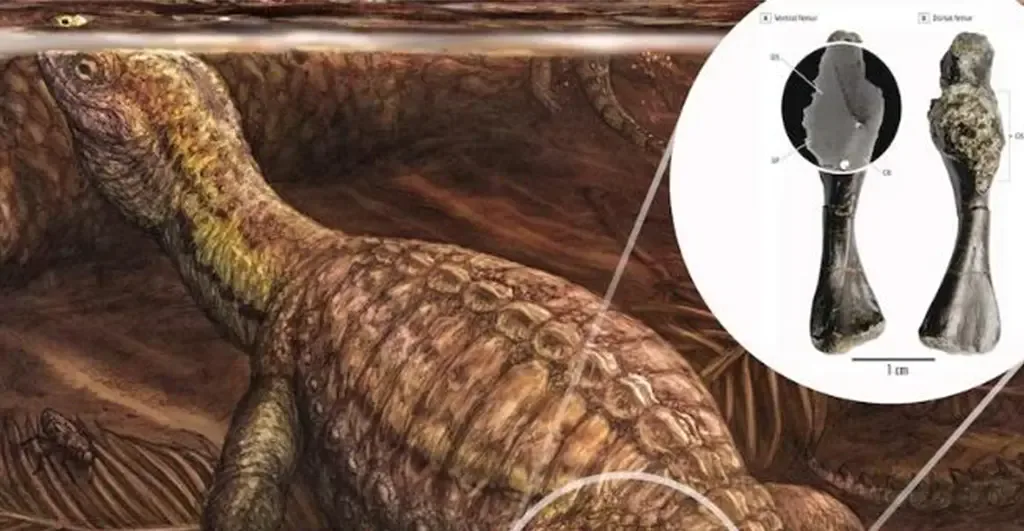
Pappochelys rosinae reconstruction with femoral osteosarcoma fossil inset

03 · Ancient disease

Cancer in the Triassic: Pappochelys rosinae

Osteosarcoma · ~240 million years

A malignant tumour in the femur of a turtle-like stem reptile shows cancer was already present in Triassic life.

In published paleopathology work on Pappochelys rosinae (a stem-turtle often called a grandfather of turtles), a femoral lesion consistent with osteosarcoma records malignancy from roughly 240 million years ago. Cancer is prehistoric, not a modern invention of urban life alone.

Life reconstruction and fossil inset: Brian Engh.

04 · Multi-hit and age

Not every mutation becomes cancer

As a rule of thumb, malignancy usually needs multiple mutations, often a double-digit count, before a cell turns possibly cancerous. An inherited defect counts as one predisposing hit, not the whole story. Time is therefore a precondition, which is why cancer is so often a disease of older age.

Beyond sporadic outside assaults on DNA, ordinary self-renewal can introduce progressive errors when replication accuracy slips. The body replaces about 330 billion cells daily. Division is like photocopying the same page again and again: sharpness drifts. Random transcription or replicative errors that alter DNA are inevitable at that scale.

According to the National Cancer Institute, the average age of people first diagnosed with cancer in 2020 framing is about 66: roughly half of cases arise at 66 or older, and risk keeps rising with age. Live long enough and the odds of a clinically important mutation stack become hard to ignore.

05 · Mutation types and defences

Somatic vs germline, TP53, and telomeres

Mutations fall into two major classes. Germline refers to reproductive cells; all other cells are somatic. DNA damage that is not repaired in non-replicating cells mainly accelerates ageing. The same unrepaired damage in replicating cells or stem cells can become a lasting mutation. Germline mutations arise in gametes and can pass to offspring, with every cell of that child carrying the change. Only about 2% of DNA codes for genes, so many sporadic alterations never touch functional sequence and remain harmless.

The mutations that count toward malignancy are those in oncogenes, tumour-suppressor genes, or cell-cycle controllers that create a clonal population with a clear proliferative advantage. Cells are not defenceless. Tumour-suppressor and immune systems repair or arrest DNA damage and, when damage is irreparable, can end the cell through apoptosis (programmed cell death).

The TP53 gene instructs production of tumour protein p53, often called the guardian of the genome. As a tumour suppressor, p53 keeps cells from growing and dividing without control. Telomeres at both ends of each chromosome maintain chromosomal stability and limit how many times a cell can divide. That replication ceiling is another brake on malignant proliferation.

06 · Three triggers

Hereditary, environmental, and replicative

Across 32 cancer types, Tomasetti, Li, and Vogelstein (2017) attributed cancer-promoting mutations roughly as below. Organ patterns still deviate: pancreatic cancers lean replicative; lung cancers lean environmental.

1. Replicative (~66%)

Random errors during cell division in various organs across a lifetime. The largest share in the 2017 multi-cancer analysis.

2. Environmental (~29%)

Outside insults that damage DNA: tobacco smoke, UV, and other exposures that vary by organ and setting.

3. Hereditary (~5%)

Inherited predisposition passed through the germ line. Real, and less common than mutations that accumulate with division and age.

Cancer is ancient, yet its grip increasingly reaches younger people as well. The same mutational force that, under restraint, carried life through 530 million years of adversity can, in rage, drive malignancy inside a human lifespan.

When genetics and risk feel personal

Bring family history, screening notes, or specialist reports if you have them. We will place this biology framing beside practical next steps without overselling certainty.

07 · Apoptosis story

Fingers, toes, and what happens when death programmes fail

Early in gestation, human embryonic fingers and toes are webbed, a quiet echo of aquatic ancestry. Before about the eighth week, connecting tissue dissolves and separate digits emerge through apoptosis, guided in part by Sonic Hedgehog signalling. Babies born with fused digits have syndactyly, a failure of that programme.

Loss of apoptosis that leaves cells effectively immortal is one of the principal routes into cancer. Life holds mechanisms that are elegant when they work and costly when they fail. This opinion only opens the door. Going deeper will be more demanding; the storyteller’s job, in Einstein’s words, is to make it as simple as possible but no simpler.

Continue with modifiable lifestyle risk, contemporary treatment options, and TCM alongside cancer care.

Dr Kevin Tang

Clinically reviewed

Reviewed by Dr Kevin Tang

Consultant Physician · TCMPB T0502026E

MOH-licensed TCM physician with clinical work in TCM oncology, rehabilitation after oncological complications, pain management, and related complex patterns.

View full profile

Educational opinion based on clinical experience, evolutionary biology, and published cancer genetics. Not a substitute for oncology, haematology, or other specialist medical care. Does not diagnose, treat, or cure cancer. Screening and specialist advice remain essential. Seek urgent care for acute symptoms, unexplained bleeding, or emergencies.

FAQs

Questions, answered

Common questions on cancer mutations, ageing, and cellular defence before a consult.

Why is cancer linked to ageing?

Malignancy usually needs multiple mutations, often a double-digit count, before a cell gains a lasting growth advantage. Time is a precondition for those hits to accumulate. The body replaces about 330 billion cells a day, so random copying errors add up. National Cancer Institute data cited in this opinion put the average age at first diagnosis around 66, with risk rising further with age.

Do all gene mutations cause cancer?

No. Most mutations are harmless or even adaptive. Only about 2% of DNA codes for genes, so many alterations never touch functional sequence. Cancer-relevant hits are those in oncogenes, tumour-suppressor genes, or cell-cycle controllers that create a clonal proliferative advantage.

What share of mutations are random vs environmental vs inherited?

Across 32 cancer types, Tomasetti, Li, and Vogelstein (2017) attributed about 66% of cancer-promoting mutations to random errors during cell division, 29% to environmental causes, and 5% to inheritance. Organ patterns still differ: pancreatic cancers lean replicative; lung cancers lean environmental.

What do TP53 and telomeres do in cancer defence?

TP53 instructs production of p53, often called the guardian of the genome. As a tumour suppressor it slows uncontrolled division and can steer irreparably damaged cells toward apoptosis. Telomeres cap chromosomes, protect stability, and limit how many times a cell can divide, which helps brake malignant proliferation.

What is the difference between somatic and germline mutations?

Germline mutations arise in reproductive cells and can pass to every cell of an offspring. Somatic mutations arise in other tissues. Unrepaired damage in non-replicating cells mainly accelerates ageing; the same damage in replicating or stem cells can become a lasting mutation.

References

Selected sources

  1. Tomasetti C, Li L, Vogelstein B. Stem cell divisions, somatic mutations, cancer etiology, and cancer prevention. Science. 2017;355(6331):1330–1334. https://doi.org/10.1126/science.aaf9011
  2. National Cancer Institute. Age and cancer risk. https://www.cancer.gov/about-cancer/causes-prevention/risk/age
  3. Haridy Y, Witzmann F, Asbach P, et al. Triassic Cancer-Osteosarcoma in a 240-Million-Year-Old Stem-Turtle. JAMA Oncol. 2019;5(4):425-426. https://doi.org/10.1001/jamaoncol.2018.6766
  4. National Center for Complementary and Integrative Health. Traditional Chinese Medicine: What You Need To Know. 2019. https://www.nccih.nih.gov/health/traditional-chinese-medicine-what-you-need-to-know/
  5. World Health Organization. Traditional, complementary and integrative medicine. https://www.who.int/health-topics/traditional-complementary-and-integrative-medicine
  6. Ministry of Health Singapore. TCM practitioners (Healthcare Professional Portal). https://hpp.moh.gov.sg/tcm-practitioners/

Book

Start with an oncology-support consult

Bring specialist notes if you have them. We will place evolutionary framing beside practical next steps without overselling certainty.

Hours
Most clinics daily 11:00 AM – 8:00 PM
Care
Physician-led consultation