

01 · Causes
Why early detection and treatment stay central
Hereditary · Environmental · Replicative
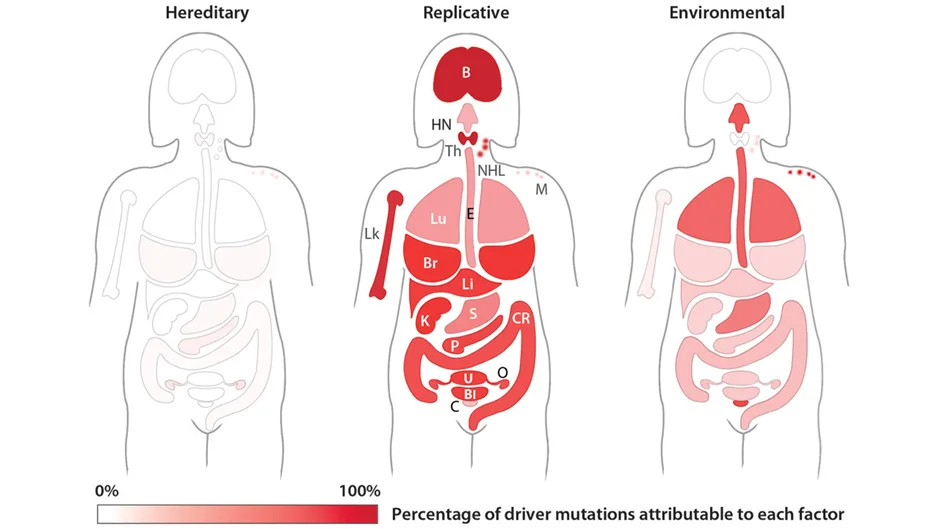
Across 32 cancer types, Tomasetti and Vogelstein attributed about 66% of cancer-promoting mutations to random errors during cell division, 29% to environmental causes, and 5% to inheritance.
Cancer-promoting mutations arise from hereditary predisposition, environmental exposure, and replicative errors during DNA copying in normal stem cells. Lifestyle change can still cut avoidable risk, yet the 2015 and 2017 Tomasetti and Vogelstein findings reframed how often random “bad luck” during cell division sits behind those mutations.
Most cancers develop from a mix of environment and random replicative errors as a tumour moves from initiation to clinical detection, rather than from a single inherited faulty cancer gene. Inherited predisposition is real, and less common than mutations that accumulate with ageing and division.
The research did not argue for abandoning prevention. It prioritised early detection and effective treatment when disease risk cannot be fully engineered away. The sections below map what contemporary care uses, when each lane fits, and which toxicities most often limit the plan.
Credit: C. Tomasetti et al., Science (2017).